

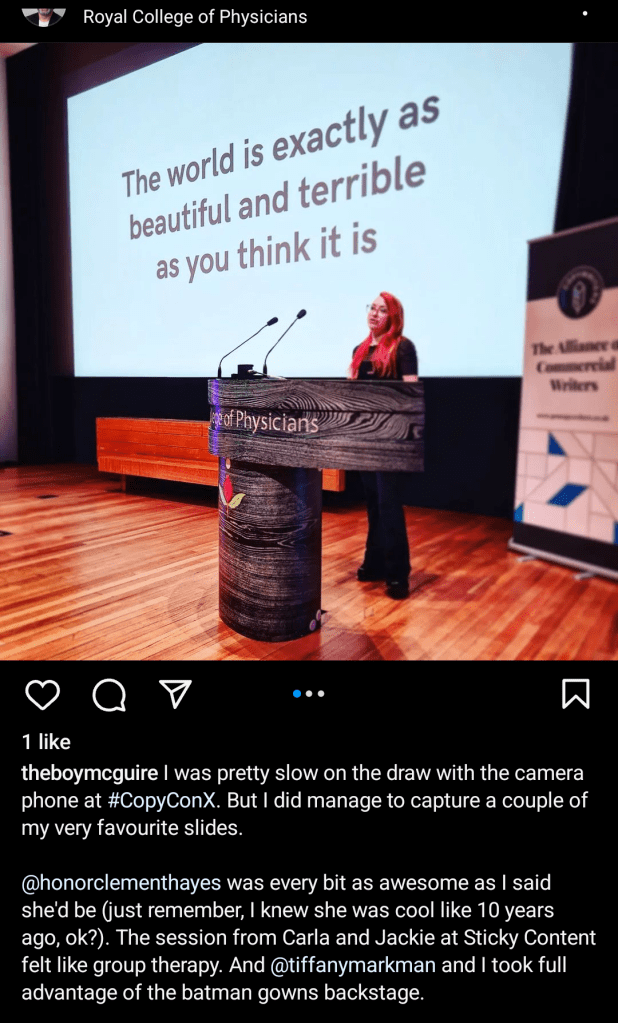
I am, famously, not a doctor. Or scientist. Or practical person of any kind. So what on EARTH was I doing at the front of a lecture hall at the Royal College of Physicians on Friday?
Talking about creatives and their brains, of course.
I’ve been a professional copywriter for well over a decade, but I rarely presume to tell someone how to actually write copy. Mainly because I don’t know. It’s something you have or you don’t, I think. No idea how it happens.
When I speak for creatives, I speak about what I do know: that we are all fragile beings with personal struggles and strengths that we need to look after in order to do our best work without dying of it.
So, that’s what I was doing in a building for smart people on Friday. The venue was very cool but entirely random. No one offered me an honorary degree or portrait sitting or anything.

It was nice though, because people were very sweet to me. Which I needed, as I was in the odd situation of being nervous in theory. The beta blockers I take every day seemed to have rendered me incapable of the physical jitters I associated with public speaking in the past. I delivered this talk from outside of my body and with zero thoughts, rather than trapped in a rattling cage of anxiety.
Unfortunately, although that sounds useful, it means I didn’t feel any real sense of accomplishment. No adrenaline rush, no oh-my-God-am-I-actually-good-at-this. Just glad it was done, with the faint sense of not having been up to much. I’m familiar with that professionally (faulty reward receptors), but never in such an extreme situation as this kind of public speaking.
It’s one of the reasons I’ve sought diagnosis: to find the right medication for the problem, rather than a whole batch of stuff pummelling various symptoms. Beta blockers have for sure changed my life – just not always for the better.
HOWEVER, lots of people felt connected to what I had to say, and told me so. Bless them for it. I think the only thing you can do as a know-nothing little mouse girl is be vulnerable. It’s the hardest thing in the world, but people grab onto it desperately, like your affirmations are their lifebelt.
Whenever I talk about neurodivergence, young women in particular can’t stop themselves spilling their guts. I’m now in the fortunate position of being able to impose most of the adaptations I need at work without a piece of paper detailing my diagnosis (although why did I never expect that grace for ‘just’ anxiety and depression?), but for a lot of people, it’s a hardship they live with secretly every day.
They’re afraid to tell their employer, or they’re ashamed because they think people will see it as following the trend (a trend that is mostly due to women starting to realise they don’t have to live sweetly in misery all their lives).
It’s SO HARD to get a diagnosis, because of the incredibly long wait lists and less-than-evolved knowledge of neurodivergence in women. And then it’s also a battle to get through the feelings of shame and doubt that come along for the ride. Am I crazy enough? Am I just lacking as a person? Am I being a princess about normal stuff?
It’s so funny that if you wrote down our issues on paper and gave them back to us, we’d be like “Um, yes, this person is having a super shit time and needs help.” Yeah, that’s YOU, babe. You need help. You deserve help. What grownup woman has time to invent stuff to make her life harder?
So, I may not be a physician, but I am a voice in the dark. I haven’t solved everything for me and I can’t solve it for you, but I will reach out a hand for you to grab and tell you that you are not imagining it.
x
 Arch Creative
Am I right? Tell me!