

Cognitive bias exists to give us shortcuts, cutting down the processing power needed by our brains. Instead of analysing all the data, considering our response and then making a decision, we can make a split-second call. So fast! So easy!
AI is the biggest mental shortcut we’ve come up with to date. Our bias is towards what is easy, so we rely on the biased robot to think for us. Bias squared.
Although what I’m doing is not for brain replacement, I’m building my own bias into AI; I hope for good. My lived experience is going into this work, as it always has, and I favour kindness and empathy. That’s why we need a more diverse group training AI. To derisk it for humanity, we need a far wider variety of humans at the wheel.
However, AI itself isn’t taking shortcuts: it’s actually checking all the information it has access to in real time. Humans are just USING it as a mental shortcut, accepting its results without critical thinking or active thinking at all.
I have a suspicion that neurodivergent people may have access to fewer mental shortcuts. It’s a fact that we collect more data and find more patterns – but also see tasks as overwhelming, because we envision every tiny step involved. Is that why we burn out? Perhaps our thinking processes are more active and exhausting because we’re not able to rely on all the shortcuts regular people use.
A bias I recognise in myself is seizing on patterns to make a good story. Facts are less important than narrative in my brain. Dangerous. None of my personal writing would stand up to peer review; I’m just vibing. I’m extra careful in my professional work to question sources and investigate claims because failing in that can lead to disaster. Unless you’re a politician.
We all look for patterns where there are none, which helps us protect our status quo and our belief system. Many Americans see the immigrants detained by ICE who have committed crimes (32%) and not the immigrants detained by ICE with no criminal history (41%).
Repeated exposure to a lie eventually convinces us it’s true, even if we initially thought it was a lie. That’s the illusory truth effect: we remember the repetition and forget the context. We’ll also continue with a hypothesis even after being told it’s wrong. That’s belief perseverance: we’ll keep working at our favoured hypothesis, fitting in new evidence that lets us continue to believe. The BLUNTEST heuristics are being used against us time and time again. It’s not sophisticated, but it works.
Picture this experiment: you’re told to observe a group of people in different coloured shirts. Your job is to count how many times the people in a certain colour pass a ball to each other. You’re so focused on your task that you don’t notice someone in a gorilla suit come into the room, turn to the camera, beat their chest and leave.
Fifty percent of people in this study did not notice the gorilla. Fifty percent of people did not notice what was right in front of them because their attention had been carefully directed towards one specific thing. It’s called inattentional blindness.
I worry about this when things like the Epstein file dumps happen. We’ve been bombarded with millions of random, unsorted, unverified pieces of traumatising information. It’s taking up so much of our processing power, our emotional bandwidth, that I worry about what is happening right in front of us that we’re not seeing. Outrage is such a big feeling – so what is it helping us ignore? Something worse is going on, and if it’s hard to imagine something worse than raping children and casually chatting about eating human meat, that’s how they’ve got us.
A regular brain will protect its owner from constantly scanning for doom. Most brains don’t do that level of hypervigilance because it’s inefficient for your health, mental wellbeing and concentration. A neurodivergent brain may feel the vibe switch and start putting together clues to what’s really happening. They’ll smell doom coming before the flame appears. It’s not good for them, because they’re living in that negative energy before anything has even happened, but it means they can be preparing for it. They’re the bellwether, trying to keep others safe against their will. Cassandras. It’s why we’re thought ‘weird’ or ‘rude’ or ‘too much’. We encroach on your comfort.
Which is the whole point of cognitive bias: to keep you comfortable, in homeostasis. When we’re interviewing a person for a job, whether we like it or not, we’re looking for someone who’s going to fit in with our comfort – who thinks the same way and behaves the same way. People who look different, people who think differently, may challenge our comfort. Then, after the fact, we justify our decision by filling the gaps with proof like, ‘This 30-something white man was the best candidate because of his experience’. We do this retrospective patching so quickly that it becomes our reality.
Diversity programmes exist to make up for this bias and put marginalised people on a slightly more level playing field. They’re there because if we let bias rule, we’ll perpetuate male, pale, stale leadership in all walks of life. And nothing will change. Of course, the fight against DEI is for that very reason: we don’t want diversity of thought in our systems! We don’t want change! We don’t want new voices! Drones only, please.
So, what can we do? Firstly, we can accept that we all have these biases. They’re nearly impossible for us to spot in ourselves (though we’re much better at calling them out in others), but we have to just decide to acknowledge it: I have bias. I am not capable of making a choice that isn’t influenced by who I am and my experience of this world. My truth is not universal. My reality is not real.
Secondly, we can look out for it in what’s communicated to us from places of power. Governments, organisations – they know this stuff and they use it against us constantly. All marketing, including the marketing of politics, relies on manipulating our biases. When something feels odd, apply a few cognitive bias theories. They’ve got access to the same wheel you have.
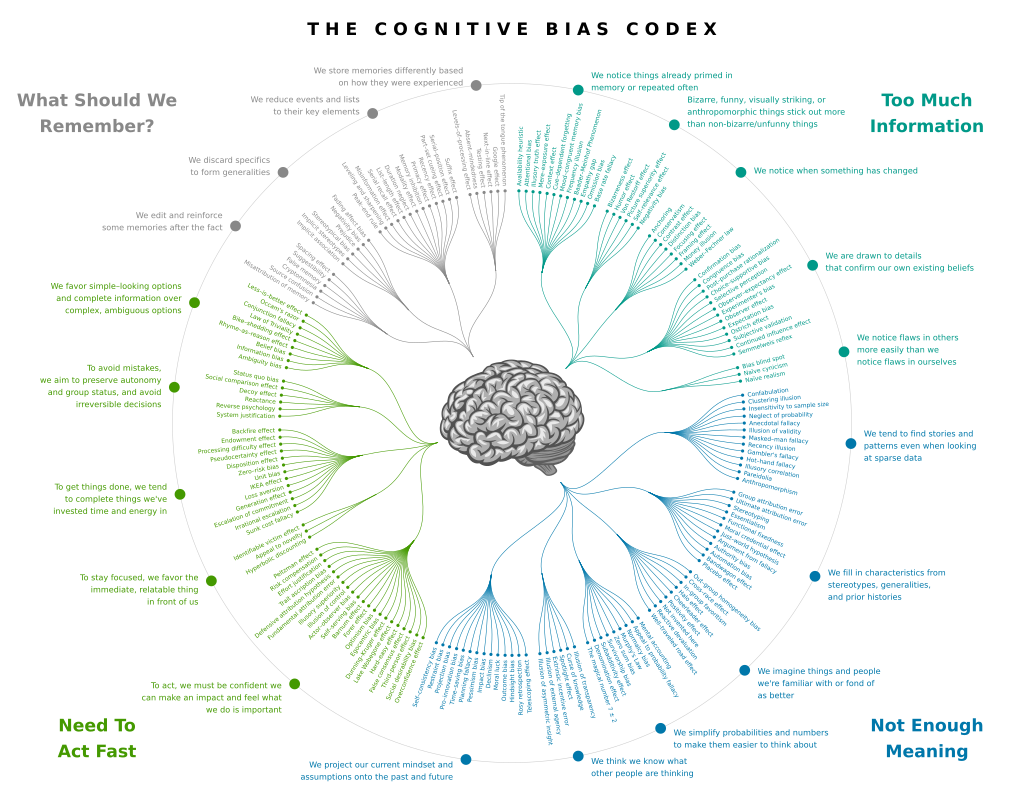
Question, question and question further. We have a right to think and reason and check and challenge. Use that right. Don’t outsource your brain to AI when that only makes you more easy to manipulate.
Diversify your data: read all sides, listen to people and consider at least that they are as invested in their beliefs as you are, and there is no empirical ‘truth’ anyway. Changing your mind as you find new data is a gift of free will, but we hate it because it’s uncomfortable. Like anything, once you start practising, it gets easier. It’s admirable to stay open and admit you don’t know, or you were wrong, or things might have changed.
All of this is hard work. It’s fighting entrenched neural pathways you don’t even know you have. But, baby, we can build new pathways for our journey forward together, and the going will get easier.
 Arch Creative
Am I right? Tell me!