My relationship with work has completely changed. I’m thinking about my work more often, more deeply and at different times of the day. Ideas can’t be contained by a nine-to-five: they spill over, messily, into everything.
A writer has always known this – I remember reading about the vital glass of cogitation whisky in the 1930s book The Technique for Having Ideas by James Webb Young. An idea will continue to be unconsciously worked through as you set about other things; it therefore cannot be ruled by things like ‘the work day’. Last night I dreamed an idea for combining several datapoints for a PR story, not from stress but from excitement.
Work is now more like play in some aspects, so there’s no reason I wouldn’t pick my laptop back up after dinner – it’s fun and I’m motivated. The work is just the material; the process is the game.
Boundaries are dropping everywhere. Who does what and when we do it is blurring. That causes plenty of problems, especially with those who haven’t yet embraced it (and occasionally with those who’ve embraced it a little too quickly). But generally, this blurry, amorphous, unfixed way of working suits me down to the ground. So much of my work is now handled 100% by me, rather than by me and a team. With no one relying on me, no one to delegate to and no one I’m relying on either, there’s no waiting. No dead time. I can work and work and work and work.
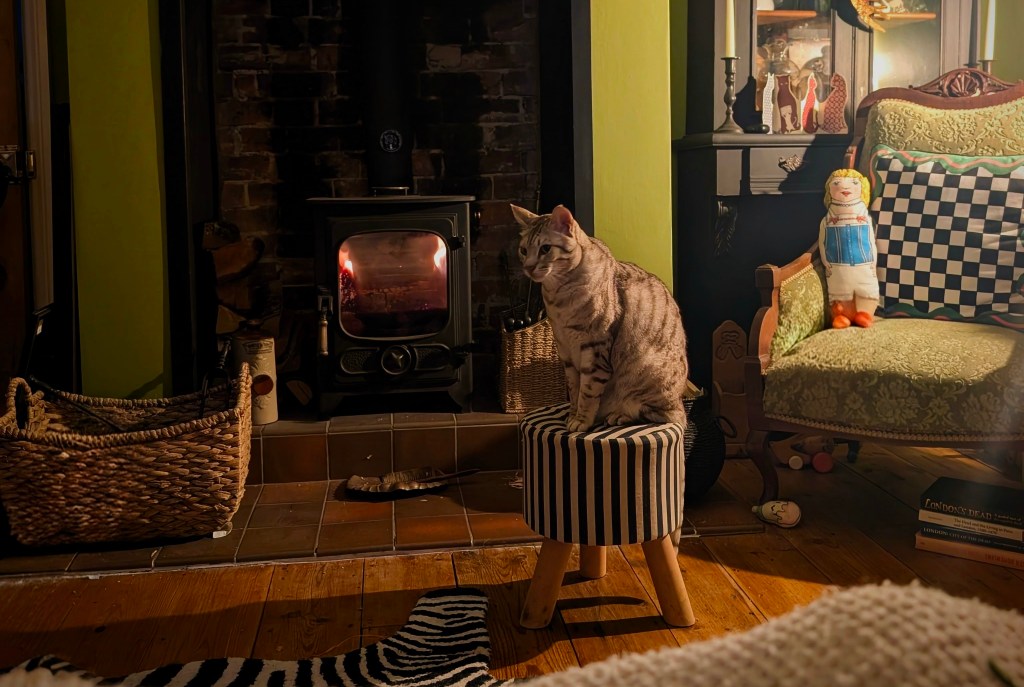
Now, that could be very bad for you if you don’t know how to stop. I do find myself working at bedtime sometimes, but only because I’m having the time of my life. When things are really cooking and everything’s coming together and I have three Claude side-quests spinning, I am in heaven. But I’m also stopping at 3pm to peel an orange and take my iron tablet in front of the fire – a two-handed little job that takes my brain away from the everything of it all. And although my job is now completely possible from my phone, a tight combination of Slack and my ever-growing Claude workspace, I find that freeing, not tethering. It means I don’t have to put down what I’m doing to go for a walk or I can immediately act on an idea if it comes to me when I’m knee-deep in river mud.
I think this works well for a neurodivergent brain that has established rigor. A neurotypical, I think, is less adjusted to captaining chaos and being five people at once – they more naturally follow routines, whereas routine is not natural for the neurodivergent; it is at first a battle and then a practice. A baby neurodivergent could easily be lost and overwhelmed and overworked. For me, I’m right where I’m meant to be. I’m blessed to be doing what I’m doing at this exact moment in time. It may not last, but I can pivot like a fucking ballerina, my dudes. I’m spinning, spinning, spinning, spinning.
When I quit Instagram, I freed up a whole lot of unproductive time. Some of it, I’ve filled with learning to read again, but some of it has gone into expanding my skills. I’ve vibe coded my first website, my first app. I’ve written a business plan and put together cost calculators. I wrote my will! For a brain that has always, always been motivated by curiosity, we’re living in an age of limitless access to knowledge and skill growth.
Now, here be dragons. Of course. I am painfully aware of the issues that arise from non-experts having access to expert skills without the experience or critical thinking to wield them safely. I check myself, I question everything. I ask experts, while trying not to dump slop on them to verify and fix. Among the smart work pals I’ve trusted for many years, we’re establishing an unsaid network of semi-autonomous beings who interface when necessary and enable each other’s continued solo growth. We want to see and to show. It’s bizarre, how different and yet how obvious that is.
I said six months ago that I wanted to be a roving consultant in the business, and that has come to pass. I belong nowhere and everywhere, drifting from project to project as needed. When I’m not stationed somewhere, I’m working on my self-contained projects. The satisfaction I get from both is immense. On the one hand, solving a problem and then leaving; on the other, ongoing, complex, evolving deep work with no dependents.
I love to leave and I love to luxuriate. Being the person who has the idea but doesn’t have to stick around to clean up and measure things is so much fun. And then for my own work, being the only person, who must sweep and mop and maintain the things I’m passionate about – that is satisfaction itself. Never moving too fast for anyone and no one to explain to unless I want to. I have achieved Nirvana.
Wait, that tickled something in my brain – what is Nirvana? It is the state of having achieved three pillars of enlightenment: ethics, discipline and wisdom. Our use of AI could easily be governed by those tenets:
- Careful use, that doesn’t harm people and doesn’t generate frustrating work for the people around us.
- Restraint and the practice of manual work for fun and for exercise. Avoiding over-production at the cost of quality.
- Critical thinking, self-reflection and the awareness that we do not know everything. I think the ability to recognise and defer to a true expert is vital here.
I’m sure a Buddhist would be horrified by my application of their beliefs to AI, but hey. I’ll pick up ANYTHING and play with it. My favourite-ever teacher used to call me ‘Sponge Honor Square Pants’ because I was always listening and watching and absorbing.
Today’s world is a world for the sponges. We must only remember the fireside orange, and the mud to our knees.


Am I right? Tell me!